


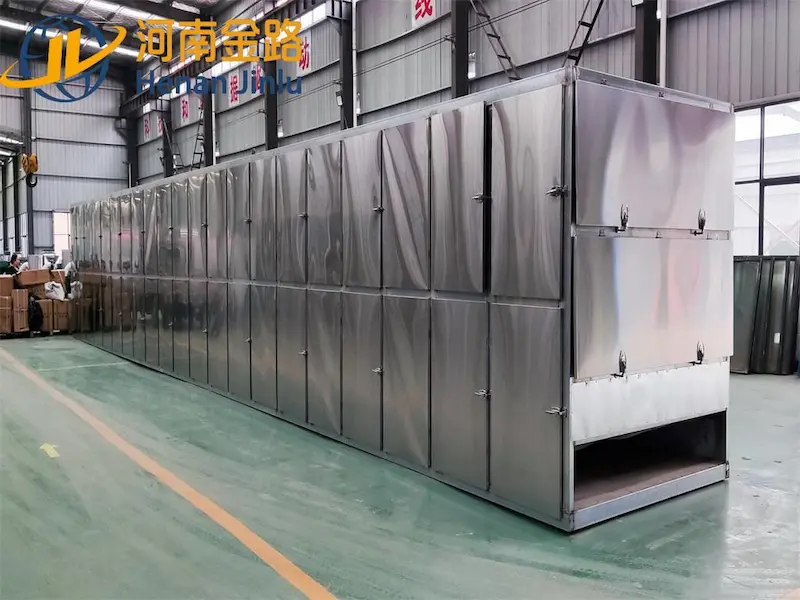
Mesh belt dryer applications span an unusually wide range in industrial processing — from animal feed and fried snack products to fruit, vegetables, and biomass pellets — because this is one of the most versatile pieces of continuous drying equipment available. But “versatile” doesn’t mean “one-size-fits-all.” The specific configuration — belt speed, zone count, layer thickness, airflow direction — needs to match the material, or throughput and quality both suffer.
This guide explains how mesh belt dryers work and how to think through configuration for your specific material.
How a Mesh Belt Dryer Works
In a typical mesh belt dryer application, material is spread evenly across a continuously moving mesh belt, which carries it through a series of enclosed drying zones. Hot air is forced through the material bed — either from below, above, or alternating — evaporating moisture as the belt advances. Multi-tier designs stack several belt layers, with material dropping from one tier to the next, which both saves floor space and naturally re-mixes and loosens the material for more uniform drying.
Because the process is continuous rather than batch, mesh belt dryers are well suited to operations that need steady, high-volume, 24/7 throughput — a meaningful advantage over batch drying rooms for large-scale production.
Materials Well Suited to Mesh Belt Drying
The range of mesh belt dryer applications is wide, but not universal — here’s where this equipment consistently performs well:
- Animal feed and pellets — uniform drying at scale, with the ability to handle the continuous flow rates that feed mills require
- Fried and extruded snack products (e.g., French fries, chips) — where uniform texture across a batch directly affects product quality
- Fruits and vegetables — sliced or whole, where gentle, even airflow preserves color, nutrients, and shape better than aggressive single-pass drying
- Herbs and spices — where aroma and active compound preservation depend on controlled, lower-temperature drying
- Biomass materials — wood chips, pellets, agricultural residue, where high throughput and moderate temperature control matter more than delicate handling
Key Configuration Parameters for a Mesh Belt Dryer
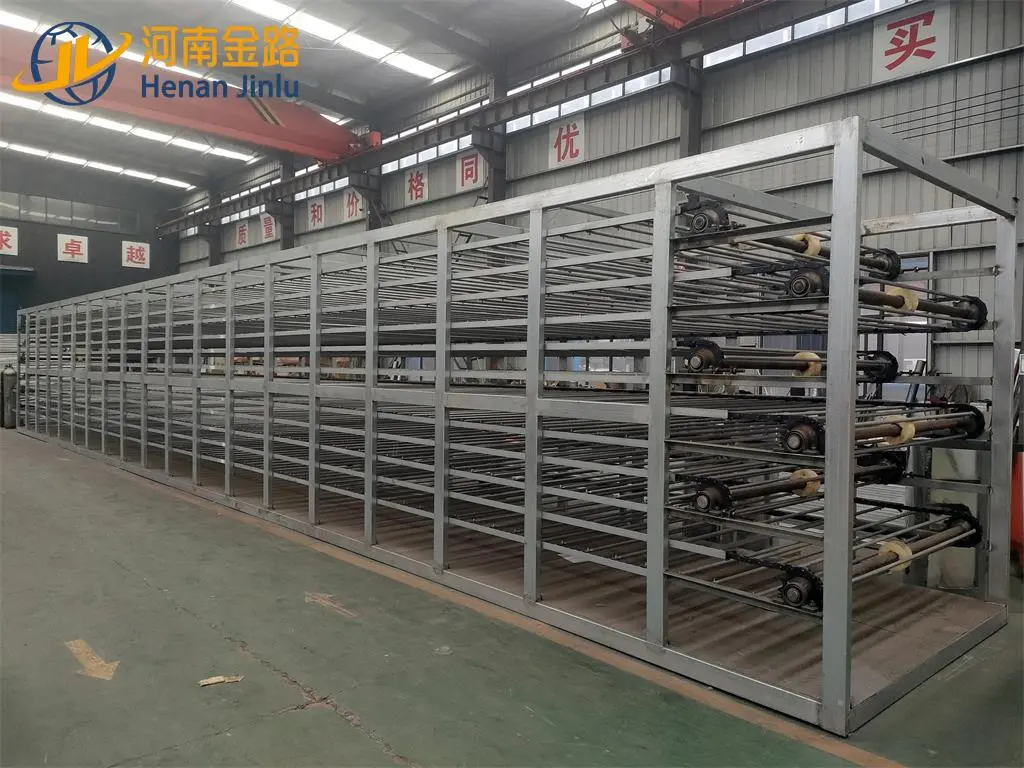
Belt speed
Determines residence time. Too fast, and material exits under-dried; too slow, and you waste energy over-drying while limiting throughput. Belt speed should be tuned per material — this isn’t a “set once” parameter, it’s typically adjusted seasonally or per feedstock batch as incoming moisture varies.
Layer thickness
A thicker material layer increases throughput per pass but risks uneven drying — air struggles to penetrate evenly through a deep bed, leaving material near the belt surface wetter than the top layer. Thinner layers dry more evenly but reduce throughput per unit of floor space. The right balance depends on material density and how well the airflow system is engineered to penetrate the bed.
Number of drying zones
Multi-zone systems allow different temperature and airflow settings at different stages — for example, higher heat early to drive off surface moisture quickly, followed by gentler heat later to avoid case-hardening (where the outer surface dries and hardens before internal moisture has escaped, trapping it inside).
Airflow direction (through-flow vs. cross-flow)
Through-flow (air passing vertically through the mesh and material) tends to produce more even drying for granular or particulate materials. Cross-flow (air passing horizontally over the material) is sometimes preferred for delicate items where minimizing material disturbance matters.
Mesh size
Belt mesh opening size needs to match material particle size — too coarse, and small particles fall through; too fine, and airflow resistance increases, reducing drying efficiency. This is a frequently overlooked spec that has outsized impact on both product loss and energy consumption.
A Common Mistake: Configuring for “Typical” Material Instead of the Full Range
Many operations process material with real seasonal or batch-to-batch variability — feed ingredients, agricultural products, and recycled materials rarely arrive with perfectly consistent moisture or particle size. A system configured only for the “typical” case often underperforms at the edges of that range. Building in adjustability (variable belt speed, zone-by-zone temperature control) up front is far cheaper than retrofitting later.
Capacity Planning
Correctly sizing mesh belt dryer applications starts with throughput (kg/h or tons/day) at a given moisture reduction target — for example, reducing material from 60% to 12% moisture at a specific feed rate. When evaluating a system, always confirm:
- What moisture reduction range the throughput rating assumes (a dryer rated for light moisture reduction will underperform on heavy reduction at the same “rated” capacity)
- Whether the rating reflects your actual material density, not a generic reference material
- How the system performs at your peak intake volume, not just average
FAQ
How is a mesh belt dryer different from a drum dryer?
Mesh belt dryers handle flake, granular, or piece-form materials spread in a layer on a moving belt, and are generally gentler — well suited to food and feed products where structure matters. Drum (rotary) dryers tumble bulk material inside a rotating cylinder and are typically better suited to heavier-duty, less delicate materials like sludge, coal, or biomass waste. Mesh belt dryer applications generally favor structured, piece-form materials, while drum dryers suit bulk, irregular feedstock.
Can a mesh belt dryer handle materials with variable particle size in the same batch?
Yes, within a reasonable range, but very wide particle size variation can create uneven drying (fine particles over-dry while coarse particles stay wet). Pre-sorting or pre-processing to reduce size variability often improves overall consistency and throughput.
What’s the biggest energy-saving opportunity in mesh belt drying?
Heat recovery from exhaust air, combined with correctly tuned zone temperatures (avoiding unnecessarily high heat in later drying stages where the material has less moisture left to release), typically offers the largest efficiency gains without equipment redesign.
If you’re evaluating mesh belt dryer applications for a new material or scaling up an existing line, share your material type, moisture range, and target throughput — our engineers can recommend a configuration before you commit to a spec.